


This series reads the AI Act’s harmonised standards one requirement at a time. It begins with the regulation they all depend on. Article 40 of the AI Act does not create a standardisation system; it points to one that already exists, used across the New Legislative Framework for products, of which AI is the most recent addition. The terms the series uses throughout (harmonised standard, citation, presumption of conformity) are defined not in the AI Act but in Regulation (EU) No 1025/2012, the Standardisation Regulation. This brief sets out how that regulation works.
Provisions. Regulation (EU) No 1025/2012 on European standardisation, as amended by Regulation (EU) 2022/2480 and Regulation (EU) 2023/988, Articles 2(1)(c), 3(6), 5, 6, 10, 11, 22. Regulation (EC) No 1049/2001, Article 4(2). Case C-588/21 P, Public.Resource.Org Inc. and Right to Know CLG v European Commission, Grand Chamber, judgment of 5 March 2024, ECLI:EU:C:2024:201. Case T-631/24, International Electrotechnical Commission and ISO v Commission (pending). Commission evaluation of Regulation (EU) No 1025/2012, SWD(2025) 170, 23 June 2025. Regulation (EU) 2024/1689, Article 40.
What a harmonised standard is, in law
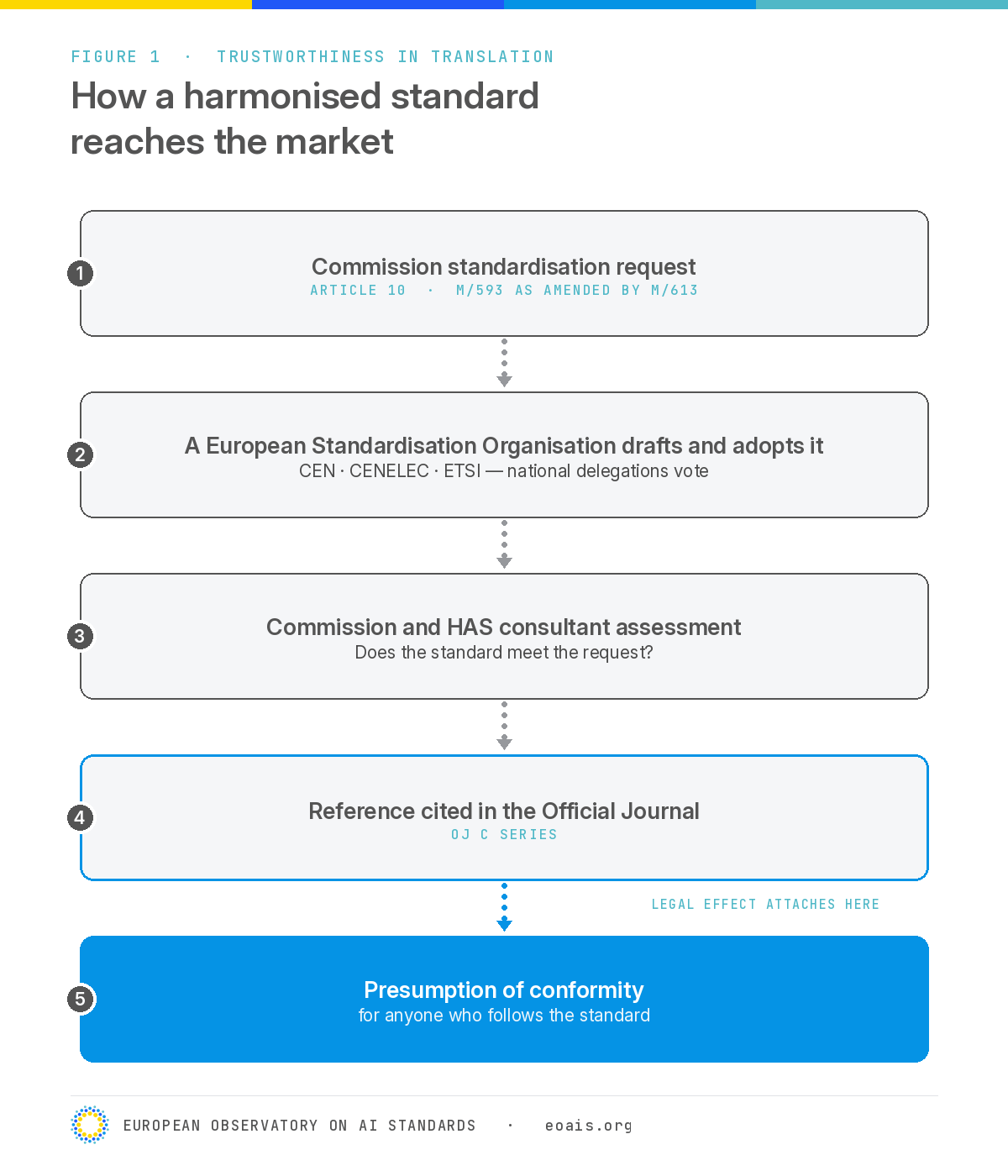
Not every European Standard published by CEN, CENELEC or ETSI is a harmonised standard in the legal sense. Article 2(1)(c) reserves the term for a European standard adopted on the basis of a request from the Commission for the application of Union harmonisation legislation. Under Article 10, the Commission issues that request after consulting the Member States, addresses it to one or more of the three European Standardisation Organisations, and may attach deadlines and specific content requirements. The AI Act’s request, M/593 as amended by M/613, is one such implementing act. The mechanism is not specific to AI: the AI Act sets out the essential requirements, and Article 40 directs that they be met through the same Article 10 process used for medical devices, machinery and pressure equipment for decades.
Regulation (EU) No 1025/2012, Article 11(1). When a Member State or the European Parliament considers that a harmonised standard does not entirely satisfy the requirements which it aims to cover and which are set out in the relevant Union harmonisation legislation, it shall inform the Commission thereof with a detailed explanation, and the Commission shall […] decide (a) to publish, not to publish or to publish with restriction the references to the harmonised standard concerned in the Official Journal, and (b) to maintain, to maintain with restriction or to withdraw those references.
The provision matters for both its content and its form. In substance it sets out the choices open to the Commission on citation: publish, decline to publish, or publish with a restriction. In form, the instrument that switches on the presumption of conformity is a Commission notice listing references, published in the C series of the Official Journal, which carries information and notices, rather than a legislative act in the L series, which carries law. That placement reflects the system’s original design. A harmonised standard is intended to be a voluntary technical document that a manufacturer may choose to follow, with the Commission publishing, as information, which documents carry a legal advantage if followed. The final section returns to what happened when that design was tested in court.
Only two actors can object
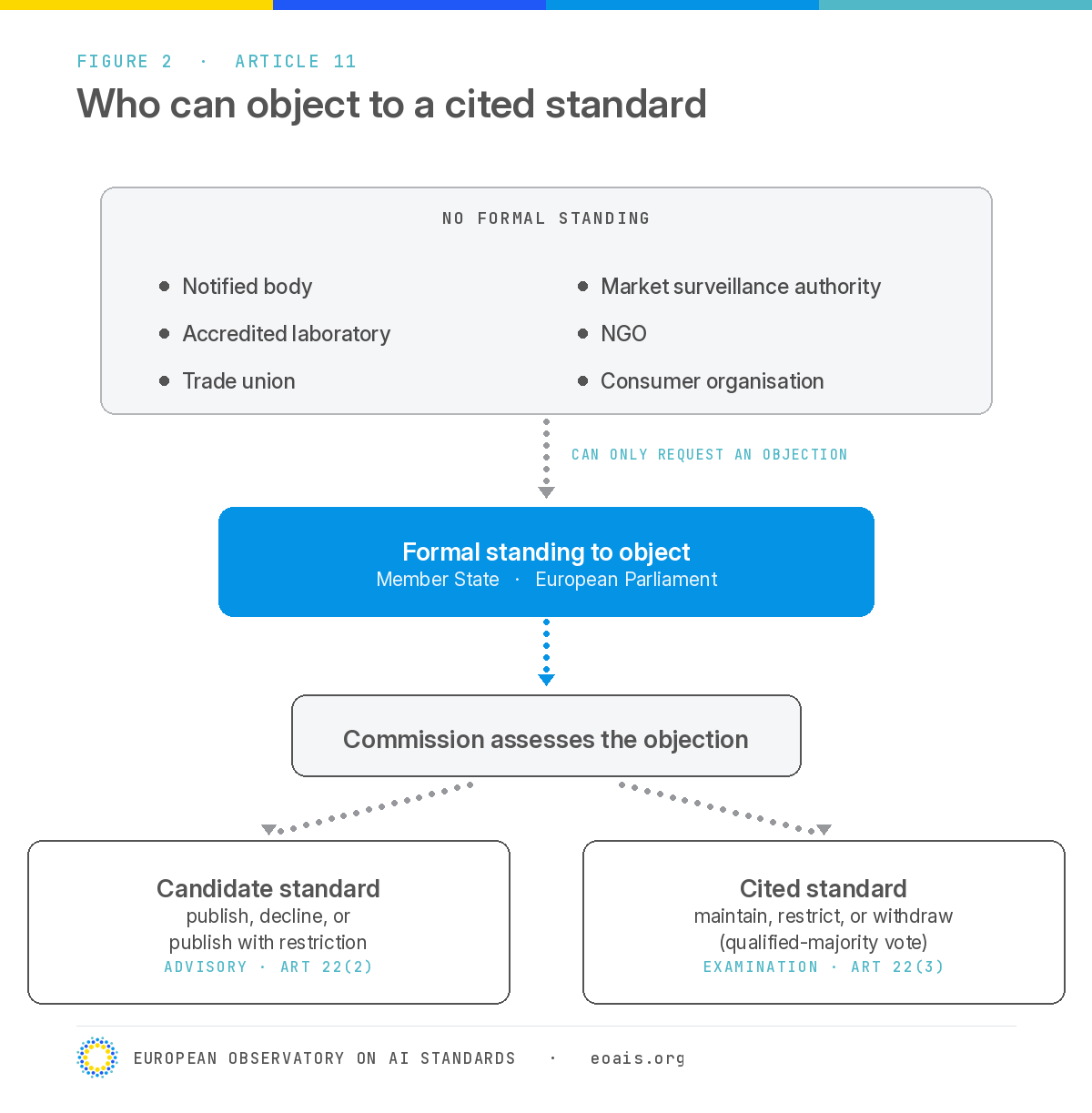
Article 11 sets out how a cited standard can be withdrawn or restricted, and it limits who can begin the process. Standing to trigger a formal objection belongs to two actors: a Member State or the European Parliament. A notified body cannot. A market surveillance authority cannot do so on its own. Nor can an accredited laboratory, an NGO, a trade union or a consumer organisation, however directly a standard affects those they represent. They can ask a Member State’s delegation or a Member of the European Parliament to file an objection, and much of the practical work around Article 11 is exactly that. The formal step, though, belongs to the state and the chamber.
What Article 11 does, mechanically. Trigger: a Member State or the European Parliament notifies the Commission, with a detailed explanation, that a cited or candidate standard fails to satisfy the requirements of the underlying legislation. Consultation: the Commission consults the committee established under that legislation, or sectoral experts if none exists. Decision on citation: publish, decline, or publish with restriction, under the advisory procedure of Article 22(2). Decision on an existing citation: maintain, maintain with restriction, or withdraw, under the examination procedure of Article 22(3), a qualified-majority vote of Member State representatives. Publication: the decision and its reasons appear in the C series and on the Commission’s public register.
Once a decision runs through Article 22(3), it is a qualified-majority vote of Member State representatives that can remove or restrict a market’s route to the presumption of conformity, over a document that no Member State wrote and the Commission did not draft. The Commission’s role here is to decide whether an objection is well founded, having requested the standard but not authored it. Separating the drafting of a standard from the adjudication of objections to it is a deliberate feature of the system.
Who takes part, and on what terms
Article 5 requires the European Standardisation Organisations to provide for appropriate representation and effective participation of relevant stakeholders, including SMEs, consumer organisations and environmental and social interests. The Regulation supports this with funding. Four European bodies, listed in Annex III as eligible recipients, take part on this basis: ANEC for consumers, ETUC for workers, ECOS for the environment, and SBS for small and medium enterprises. The funding lets them second experts into technical committees alongside industry delegations.
Funded participation is not a vote. CEN and CENELEC decide by national delegation, one member per country through its national standardisation body, so these four bodies can contribute and comment, and can raise positions through a national delegation, but they do not hold a vote that closes a draft on its own. Their influence therefore depends on sustained presence, and keeping expert time available across many technical committees is demanding. A funded seat is not the same as a filled one, and where these voices are less present it commonly reflects the resources needed to keep pace with the volume of drafting rather than any barrier to entry. Article 5 provides for the seat; using it well is largely a question of capacity.
Article 3(6) adds a standstill. Once a harmonised standard is in preparation, and after it is adopted, national standardisation bodies may not publish a conflicting national standard in the same field or take steps that would prejudice the intended harmonisation. This is why no national body publishes a competing national text while the AI standards are in enquiry. The absence of a competing standard does not by itself indicate consensus; it is what the standstill requires.
The standard is voluntary to adopt. At the same time, while it is being prepared no national body may publish a competing national alternative. In practice, the harmonised route is the one that carries a built-in legal advantage.
The regulation has been reopened before
Regulation 1025/2012 is not a fixed backdrop. It has been amended more than once. Regulation (EU) 2022/2480 requires that decisions on accepting or refusing a standardisation request, opening a new work item, and adopting, revising or withdrawing a European standard be taken by representatives of the national standardisation bodies within the ESO’s decision-making body. The background was the membership of CEN and CENELEC, which extends beyond the EU and EEA to bodies such as the United Kingdom’s BSI and Switzerland’s SNV. After the United Kingdom left the Union, the weight of non-EU members in decisions on standards that implement EU law became a live question, and the 2022 amendment, applicable from 9 July 2023, addressed it by confining those decisions to the national bodies of the states the Regulation binds. A further amendment came through the General Product Safety Regulation (EU) 2023/988, which reopened 1025/2012 as a consequential matter and applies from 13 December 2024. The Regulation has therefore been reopened before, including on a governance question that changed who votes on the drafts. The 2026 revision is the next round, not the first.
2024: the Court of Justice rules on access
For most of the system’s life, few outside the compliance industry tried to read a cited harmonised standard without paying for it. Two non-profit organisations did. Public.Resource.Org and Right to Know asked the Commission in 2018 for four harmonised standards on the chemical safety of children’s toys. The Commission refused, citing the commercial interest and copyright of CEN and the national bodies that produce and sell the texts. The General Court upheld the refusal in 2021. On appeal, the Grand Chamber of the Court of Justice reversed it on 5 March 2024, in Case C-588/21 P.
The Court held that because a cited harmonised standard produces the legal effect of a presumption of conformity with requirements that would otherwise have to be demonstrated by other means, it forms part of Union law, notwithstanding its packaging as a voluntary technical document in the C series. That status establishes an overriding public interest in disclosure under Article 4(2) of Regulation 1049/2001, sufficient to outweigh the commercial-interest and copyright objections. The Court did not remove copyright from harmonised standards; it held, more narrowly, that on request the Commission must provide a specific cited standard free of charge.
The reasoning covers the whole category of cited harmonised standards, not only the four texts in the case, so it reaches AI standards once they are cited. It has real consequences for a funding model in which CEN, CENELEC and their national members recover part of their costs by selling access to standards that typically cost a purchaser from tens to a few hundred euros each. Responses have varied. Slovenia’s national body, SIST, has made harmonised European standards available free as a matter of national policy, going beyond a case-by-case approach. Separately, ISO and IEC brought their own action, Case T-631/24, on 6 December 2024, after the Commission began extending the free-access logic to international ISO and IEC standards, including texts not yet cited as harmonised standards. The two bodies argue that C-588/21 P reaches only the EU harmonised standards listed in the Official Journal, not international standards that remain under their copyright, and that the Commission granted access without assessing an overriding public interest or its obligations under the WTO TRIPS and TBT agreements. The question is whether the free-access finding extends to international standards at all. It was pending as this brief was written.
2026: the regulation is under revision
The Commission has evaluated Regulation 1025/2012 and identified two main issues: standards are delivered more slowly than EU legislation increasingly needs, and participation is narrower than Article 5 intends. The delivery-speed issue is long-standing, and the higher legal stakes the Court’s ruling attached to every citation have not made it easier. A call for evidence and a public consultation ran during 2025, and a legislative proposal was expected in 2026; its content is not settled from outside, and this series will read it when it appears.
The submissions on record do not point in one direction. National standardisation bodies and much of industry favour a faster process with the ESOs and their national members more clearly in charge, supported by new coordination structures. ANEC, the consumer body among the Annex III organisations, has proposed that the Commission keep final responsibility for verifying that a standard complies with EU law and the Charter of Fundamental Rights before citation, and that the current HAS Consultants, the independent experts the Commission uses to check a draft before citing it, be replaced by a permanent multidisciplinary assessment structure. At least one industry association has argued the other way: no structural change beyond a narrow amendment reflecting the status the Court has given harmonised standards.
The two problems the evaluation names sit in some tension. Speeding up delivery by giving the ESOs and national bodies more control addresses the first, but the participants found to be under-represented are also those least able to keep pace with a faster timetable. A revision that shortens review windows for speed and funds more seats for inclusiveness can pull in different directions within a single text, and which effect dominates is not yet public.
What this establishes
None of this is background. Article 11 is the route by which a Member State or the European Parliament could object to any AI harmonised standard once it is cited. Article 5 sets both the promise and the limit of who is heard while a standard is drafted. Article 3(6) explains why there is no competing national text to compare it against. Article 10 is the basis for the whole M/593 to M/613 programme. And the Court of Justice has confirmed that the output of this machinery forms part of Union law. That is the framework the rest of the series reads against.
Sources
Primary instruments and case law:
Regulation (EU) 2023/988, General Product Safety Regulation, second amendment to 1025/2012
Case T-631/24, action brought 6 December 2024, OJ C/2025/919
Standardisation request and revision:
Access to standards and stakeholder positions:
Free access to European harmonised standards in Slovenia, European Commission, 8 January 2025
ANEC position on the revision, HAS Consultant replacement and the Commission’s verification role
The Blue Guide 2022, Commission Notice 2022/C 247/01, OJ C 247, 29.6.2022
The European Observatory on AI Standards is an independent reading of the EU AI Act’s harmonised standards. Analysis is the Observatory’s own and does not represent the position of CEN, CENELEC, any national standards body, or the European Commission.