



Many of the briefs after this one are written against the Regulation as adopted in June 2024, back when the Digital Omnibus was tracked as a proposal, then an agreement, then a vote. It is now law: Regulation (EU) 2026/1744 of 8 July 2026, published on 24 July, with the consolidated text carrying the date of 27 July 2026. This brief reads the consolidation, and reports what the amending act did to the architecture these briefs have been describing. Three findings, in ascending order of consequence for anyone drafting or applying a harmonised standard.
Provisions. Regulation (EU) 2024/1689 as amended by Regulation (EU) 2026/1744 (OJ L, 2026/1744, 24.7.2026); consolidated text 02024R1689 (EN), as applicable from 27 July 2026. Amended or inserted: Articles 1, 2, 3, 4, 4a, 5, 6, 10, 11, 17, 25, 27, 28–30, 40, 42, 43, 50, 56–58, 60, 60a, 63, 64, 69, 70, 72, 75, 75a–75d, 76, 77, 95–97, 99, 111, 113; Annex I Sections A and B. Regulation (EU) 2019/1020, Articles 14(4), 15, 16(3), 17, 18.
The delay
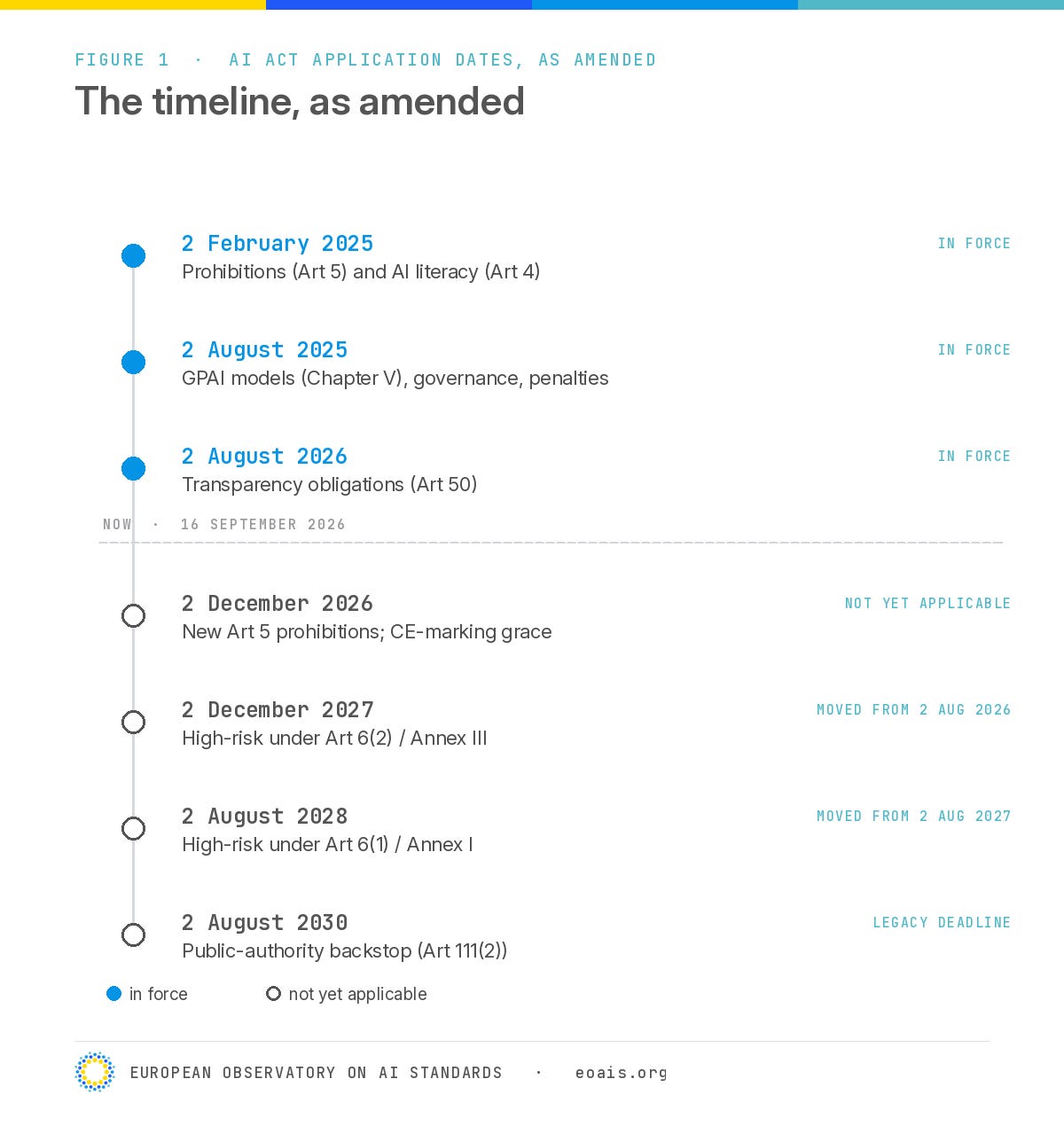
Article 113 now says what everyone has been paraphrasing. Chapter III Sections 1 to 3, with the exception of Article 6(5), apply from 2 December 2027 for systems classified as high-risk under Article 6(2) and Annex III, and from 2 August 2028 for those classified under Article 6(1) and Annex I. Chapters I and II keep their February 2025 date, save for the newly inserted prohibitions, Article 5(1) points (ba) and (bb) and Article 5(1a) and (1b), which apply from 2 December 2026. Articles 102 to 110, the amendments to the sectoral transport and product acts, applied from 27 July 2026. A hard backstop the amendment left untouched: high-risk systems intended for use by public authorities must comply by 2 August 2030 regardless of when they were placed on the market (Article 111(2)).
The regulation states the reason for the new dates. Recital 40 attributes the deferral to the delayed availability of standards, common specifications and guidance, and to the delayed designation of national competent authorities. As of mid-2026 no AI Act harmonised standard had been cited in the Official Journal; without a citation there is no Article 40 presumption to grant or to rebut, and near-term conformity claims rest on common specifications or a provider’s own justification against the essential requirements. The Commission had recorded the delay in the M/613 implementing decision of June 2025.
The reading that matters for this series is the split in point (c). The two limbs are keyed to the two classification routes, not to two categories of risk, which means the deferral is longest exactly where the AI Act meets the older product legislation and its notified-body infrastructure. Eight months separate the two, and in those eight months a provider of an Annex III system will be under market surveillance while a provider of an equivalent capability embedded in a regulated product will not. Treating the postponement as uniform relief mis-schedules by two-thirds of a year.
Changing the scope
Article 6 gained three paragraphs, and they do more work than the deferral. New paragraph 1a provides that AI systems used solely for non-safety-related aspects of user assistance, performance optimisation, service efficiency, automation, convenience or quality control shall not qualify as safety components. Paragraph 1b restores the boundary from the other side: systems whose failure or malfunctioning would endanger health and safety do qualify, whatever they are called. Paragraph 1c removes from the Article 6(1)(b) condition any product that undergoes third-party conformity assessment solely for reasons unrelated to health and safety, with radio spectrum and electromagnetic interference named as the paradigm case. And the Machinery Regulation leaves Annex I Section A: it is moved to Section B, so AI-enabled machinery is handled through the sectoral safety regime rather than the AI Act’s high-risk track directly, with the Commission required to adopt delegated acts by 2 August 2028 to carry the machinery safety-component obligations into that regime.
Take those together and the Article 6(1) route narrowed materially. A quality-control classifier on a production line, previously arguable as a safety component of a machine, now has two independent exits: the machinery legislation sits in Section B rather than Section A, and quality control is named in 1a. Whether that is good regulation is a question for others; what it does to the standards programme is not in doubt. A slice of the population the M/613 portfolio was written to serve has left the high-risk perimeter, and the drafters of every essential-requirement standard now write for a smaller and differently shaped constituency than the one they started with, with paragraph 1b as the line their scope statements have to respect.
Article 43(1) also acquired a limb worth flagging, because it converts a soft signal into a hard route. Where a harmonised standard has been published with a restriction, the provider must take the Annex VII notified-body path for the restricted part. Restriction has served as the Commission’s intermediate instrument in the citation decision; under the amended Article 43(1) it now carries an automatic, itemised procedural cost for every downstream user of the restricted clauses.
Enforcement centralised, and modelled on competition law
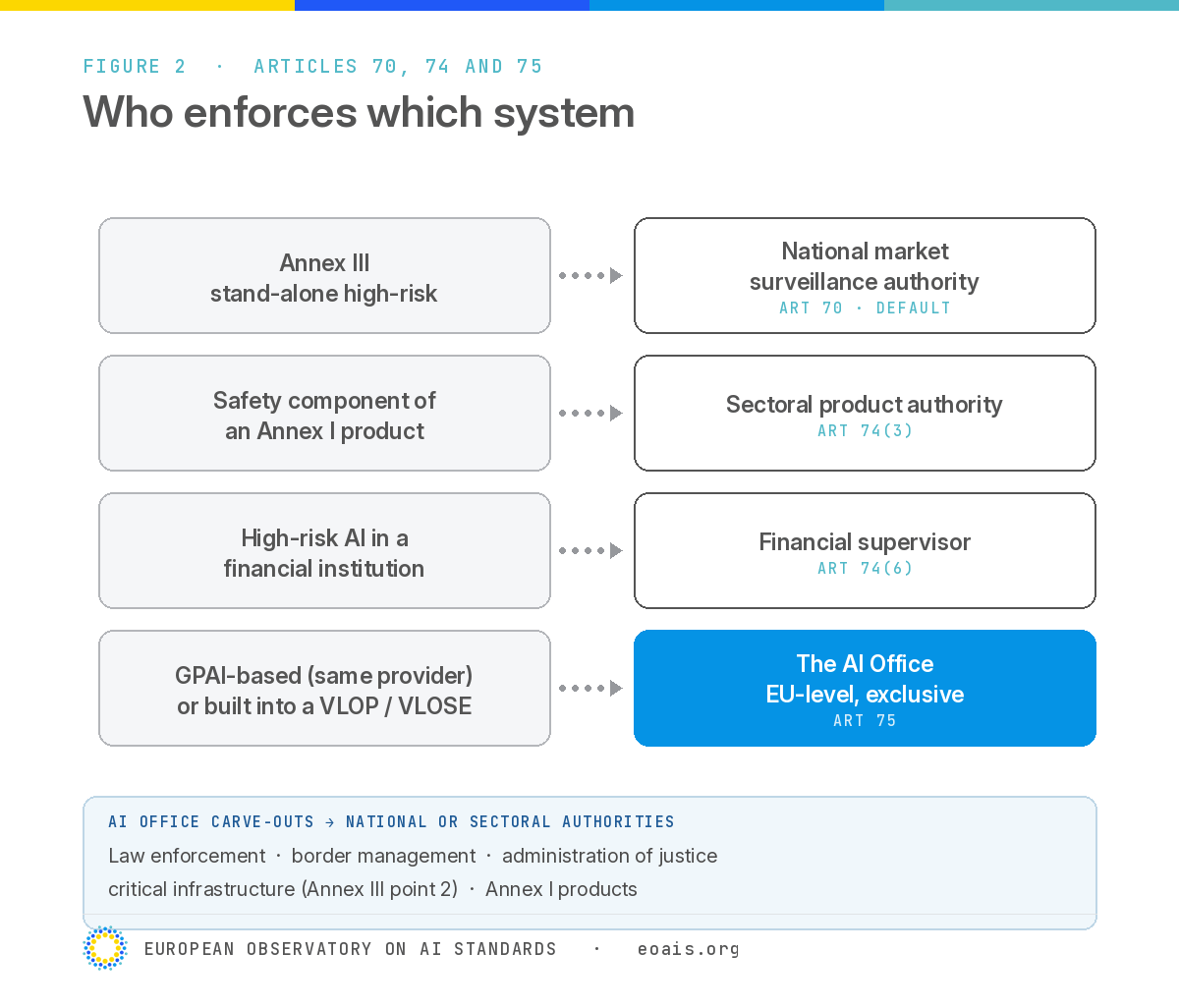
Article 75 was rewritten. The AI Office now holds exclusive competence over two classes of system: those based on a general-purpose model where model and system come from the same provider or undertaking, and those constituting or integrated into a very large online platform or search engine designated under the Digital Services Act. Four carve-outs return the politically sensitive cases to national authorities: Annex I products, Annex III point 2 critical infrastructure, law enforcement, border management and financial institutions under Article 74(6), and the administration of justice.
Around that competence the Omnibus inserted Articles 75a to 75d, and their shape will be familiar to anyone who has read a competition file. The AI Office gets all market surveillance powers plus Articles 14(4) and 16(3) of Regulation (EU) 2019/1020, and full cost recovery from a non-compliant operator. Article 75b creates a commitments procedure: an operator may offer undertakings, the Office may make them binding by decision and declare no further grounds for action, with reopening available on changed facts, breach, or incomplete information. Article 75c provides for preliminary findings communicated before decision, a non-compliance decision, orders to take necessary measures, fines and periodic penalty payments capped at 5% of average daily worldwide turnover per day. Article 75d supplies rights of defence and negotiated access to the file, business secrets protected.
Product law does not usually work this way. The Annex VI world of internal control is one of declarations, files and inspections; a commitments-and-decisions track with an EU-level authority, a settlement mechanism and a periodic penalty payment is antitrust and DSA machinery. The consequence for the standards system is direct: for frontier-model-based systems, the body assessing whether the essential requirements are met, whether the harmonised standard was correctly applied, and whether the presumption survives is a single Union regulator that also has the power to accept a negotiated remedy instead of a finding. What a harmonised standard means for that class of provider will increasingly be settled in a commitments decision rather than in twenty-seven inspections.
The Commission started writing the artefacts
The third finding is the one this series is best placed to see, because it is invisible unless you have been watching the standards programme.
Article 11 now says that SMEs, start-ups and small mid-cap companies may supply the Annex IV technical documentation in a simplified manner, that the Commission shall establish a simplified technical documentation form for them, that a company opting for simplification shall use that form, and that notified bodies shall accept the form for the purposes of the conformity assessment. Article 27 directs the AI Office to develop a template questionnaire, including an automated tool, for the fundamental rights impact assessment, and lets deployers cross-reference or import their GDPR data protection impact assessment. Article 72(3) requires the Commission, taking utmost account of the Board’s opinion, to adopt guidance including a template for the post-market monitoring plan by 2 September 2027. Article 96(1)(g) adds guidelines on the complementarity of Articles 8(2), 9(10) and 17(3) with Annex I legislation, due 1 August 2027. And Article 40(2) gained a subparagraph obliging the Commission to request, without undue delay, standardisation deliverables facilitating joint compliance and presumption of conformity across the AI Act and the Annex I sectoral acts.
Read that list as a single instrument and the pattern is unmistakable. The technical documentation form, the FRIA questionnaire, the post-market monitoring plan template, the complementarity guidelines: these are the operational artefacts of compliance, and until July 2026 the Regulation’s design was that European standardisation would supply their content, with the Commission’s role confined to requesting, assessing and citing. The Omnibus put the Commission and the AI Office directly into the artefact business, on statutory deadlines, with at least one of the outputs binding on notified bodies by its own terms.
This is not Article 41. Common specifications are the declared fallback, adopted by implementing act when standardisation fails, and they have so far remained untriggered. Templates and guidance are something else: they do not confer a presumption of conformity, they do not displace a harmonised standard, and they are adopted without the comitology and formal-objection machinery that governs common specifications. What they do is occupy the operational space around the standards, which is precisely the space where a provider decides what its file will look like. A drafting group writing a documentation clause in 2027 will be writing alongside a Commission form that SMEs are required to use and notified bodies are required to accept. The text does not assign responsibility for coordinating the two.
What to take away
The three-step motion this series (had) and now will trace inside standards- the concept narrows, the residue is reassigned, the threshold acquires an owner- has now been performed on the Act itself by its own legislature. The concept narrowed: safety component, Annex I Section A, the Article 6(1) route. The residue was reassigned: enforcement for the model-based tier to the AI Office, artefact production for the documentation tier to the Commission and the AI Office, bias-detection permission out of Article 10 and into a general Article 4a. And the threshold acquired an owner: for the systems that matter most commercially, a single Union regulator that can now settle rather than only find.
For the standards programme the practical instruction is short. The scope statements need rereading against Article 6(1a) to (1c). The documentation clauses need drafting in awareness that a Commission form is coming for part of their audience. The conformity-assessment clauses need to account for Article 43(1)(d). And the Annex ZA tables of every draft now in enquiry point at article numbers that, in one case at least, no longer exist: a standard that maps a clause to Article 10(5) is mapping to a provision that has moved to Article 4a.
Sources
The European Observatory on AI Standards is an independent reading of the EU AI Act’s harmonised standards. Analysis is the Observatory’s own and does not represent the position of CEN, CENELEC, any national standards body, or the European Commission.
The move into artefacts is the part I keep returning to. Once the Commission supplies the technical documentation form, the FRIA questionnaire and the post-market monitoring template, it is not just standardising the form: it is shaping what the operation will later be able to demonstrate as evidence.
From the deployment side, that matters because the person completing a monitoring plan is rarely the person who encounters the deviation it was meant to capture. In practice, the evidence is generated across oversight decisions, supplier tickets, workflow changes and local workarounds. The artefact can remain formally complete while the evidence needed to reconstruct what actually happened sits somewhere else.
Do you read this as a temporary consequence of the standards delay, or as a more durable shift in who defines the evidentiary structure of compliance: from standardisation towards the Commission and the AI Office?